The challenge
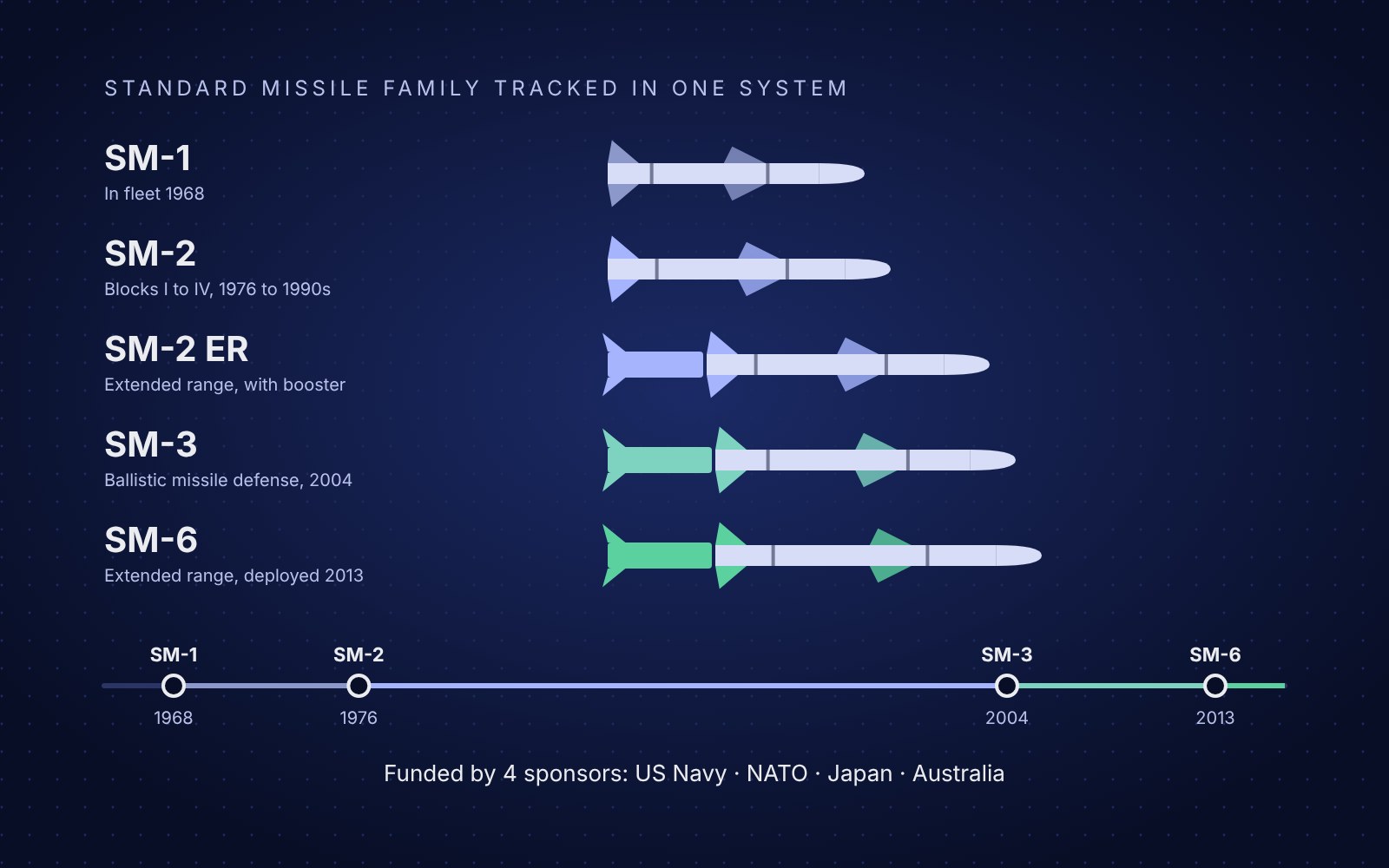
SMSMDS, the Surface Missile Systems Maintenance Data System, holds the life cycle data for every STANDARD Missile family, from SM-1 through SM-2, SM-3, and SM-6: manufacturing baselines, test data, recertification reports, trouble reports, and failure reporting.
It was the single source of inventory and maintenance data for those missiles, including our allies' missiles: every repaired part, every procedure performed (including training videos), shipping to and from the vendors, orders for new parts, each missile's status in the fleet, and overall fleet readiness. It also tracked missile maintenance for the Missile Defense Agency.
That came to $10B+ in missile assets. The SM-6s alone were worth $2.5B+ by late 2019 (582 delivered at $4.4M each, per the SM-6 Selected Acquisition Report (opens in a new tab)), SM-3s cost $11.8M to $36.4M each (The War Zone, FY2021 costs (opens in a new tab)), and more than 11,000 SM-2s had been delivered to the US and allied navies by early 2020 (Naval News (opens in a new tab)).
Four sponsors paid for it: the US Navy, NATO, Japan, and Australia. Each one had its own priorities, and they clashed in four places:
- Whose requests go first. Feature requests, fixes, and defect work orders from all four sponsors competed for one programming team.
- Funding timing. Sponsors funded on their own cycles and in different amounts.
- Data access. Each foreign partner could see only the missile data it was cleared for.
- Reporting. Every sponsor wanted its own view of what its money bought, and each one planned to fund its own custom reports.
Four custom reporting builds meant four times the cost, four things to maintain, and a team pulled in four directions.
My role
As principal program manager, I ran SMSMDS in the cybersecurity division at NSWC Corona: a 35-person division with a $7M+ budget across 6 in-house teams.
I was the single point of contact for all four sponsors. I collected program funding from each one, managed staffing and payroll for the programming team, and triaged every customer request, defect work order, update, and deployment.
How I solved it
- 1
One queue for every sponsor
Every sponsor's requests, defects, and updates went into one prioritized triage queue with clear rules, so four clients saw one plan instead of four competing ones.
- 2
Tie funding to the work
I mapped each sponsor's funding to specific work items. Priority followed funding, and every sponsor could see exactly what its money bought. Every 2 weeks I spent about 8 hours splitting each person's hours by funding source, current-year and prior-year funds for each sponsor, and moving people to another sponsor's work when one funding line ran out.
- 3
Separate the data by sponsor
Access controls made sure each partner saw only the missile data it was cleared for, so one system could serve all four without a release problem.
- 4
Build once, share the cost
Instead of funding four custom report builds, I worked with the technical team to build one shared, customizable reporting component with access levels. Each sponsor could build and deploy its own reports on it, tuned to its needs, while the cost was shared across all four.
- 5
Plan yearly, respond fast
I ran annual planning and funding reviews with the sponsors and handled issues between reviews as they came up, so no sponsor waited a year for an answer.
Results
- A multi-billion-dollar inventory: the SM-6s alone came to $2.5B+ by late 2019.
- The shared reporting component gave each sponsor reports tuned to its own needs at a combined, shared cost, saving each sponsor millions of dollars over the life of the program.
- Kept funding from all four sponsors, the US Navy, NATO, Japan, and Australia, with one visible plan instead of four competing ones.
- Shared improvements, like the move to Azure Government's IL4 secure cloud in under a year, were pitched as one cost split across sponsors. That story is in Approved to Put Restricted Military Data in the Cloud.
- What I learned: when several clients fund one product, build shared capabilities with configurable access instead of custom one-offs, tie every dollar to visible work, and run every request through one queue.
References
Sources cited on this page, plus industry standards and guidance relevant to this work.
- Standard Missile-6 (SM-6) Selected Acquisition Report (Dec 2019) (opens in a new tab)Department of Defense
- Here Is What Each Of The Navy's Ship-Launched Missiles Actually Costs (Dec 11, 2020) (opens in a new tab)The War Zone
- Raytheon, US Navy test first Standard Missile-2 from restarted production line (Feb 27, 2020) (opens in a new tab)Naval News
- DoDI 8510.01, Risk Management Framework for DoD Systems (opens in a new tab)Department of Defense
- Risk Management Framework (SP 800-37) (opens in a new tab)NIST
- SP 800-53 Rev. 5, Security and Privacy Controls (opens in a new tab)NIST
- Cloud Computing Security Requirements Guide (IL2 to IL6) (opens in a new tab)DISA, DoD Cyber Exchange