The challenge
In 2009 SDG&E began replacing 1.4 million electric meters with smart meters that record usage by the hour. The data existed, but customers had no easy way to see it.
Customers wanted to see their energy usage and respond to power outages and energy curtailment events through the in-home energy displays already on their home networks.
SDG&E had no way to share meter data with a technology partner. There was no API, no data standard, and no security model, and sharing customer data outside the utility raised hard privacy questions.
My role
I was the hands-on technical product owner. I wrote the specs and the API contract, built the entire API myself, and coordinated requirements and launch dates with Google's PowerMeter team, SDG&E's internal teams, and in-home display vendors.
How I solved it
- 1
Write the contract first
I wrote the integration specs and the API contract with Google's team, so both sides built to one definition of the data, the format, and the launch date.
- 2
Share usage, never identity
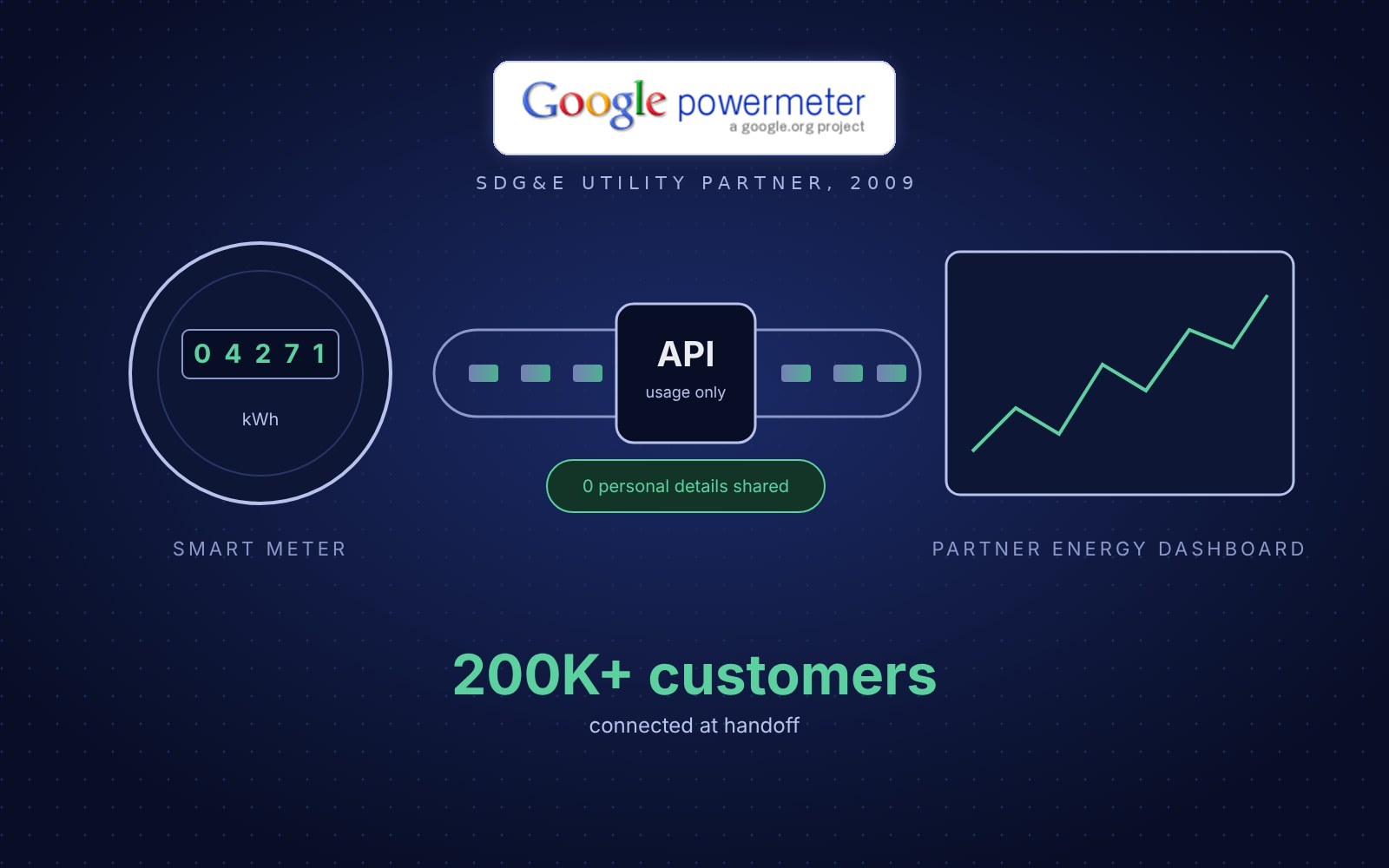
A key decision: only energy usage data went to Google. No names, addresses, or account numbers left SDG&E. That design is what got the integration through privacy, legal, and security review.
- 3
Build a platform, not a one-off
The other key decision: I built a reusable partner API instead of a custom Google feed, so later partners could connect through the same contract.
- 4
Build and launch
Building on my Energy Waves platform work, I built the entire API: production ready, real time and natively scalable, so Google could pull every connected customer's hourly metered data. No open-source or vendor standard such as OAuth existed for this yet, so Google's engineers and I designed a custom authorization layer. We launched with Google on schedule as a PowerMeter utility partner in 2009.
- 5
Hand off a running program
I grew the program to 200K+ connected customers and then handed it off to another IT team to run.
Results
- SDG&E launched with Google on schedule, and 200K+ customers had connected when I handed the program off to another IT team.
- The usage-only design passed privacy, legal, and security review with no personal customer information shared.
- The reusable partner API served later partner integrations, not only Google.
- What I learned: designing for privacy from day one turns review from a blocker into a fast yes, a platform pays off when the next partner arrives, and launch plans with a large external partner need slack for their release schedule as well as yours.
Source: Sempra, May 20, 2009: SDG&E teams with Google to provide energy usage data to customers
References
Sources cited on this page, plus industry standards and guidance relevant to this work.