The challenge
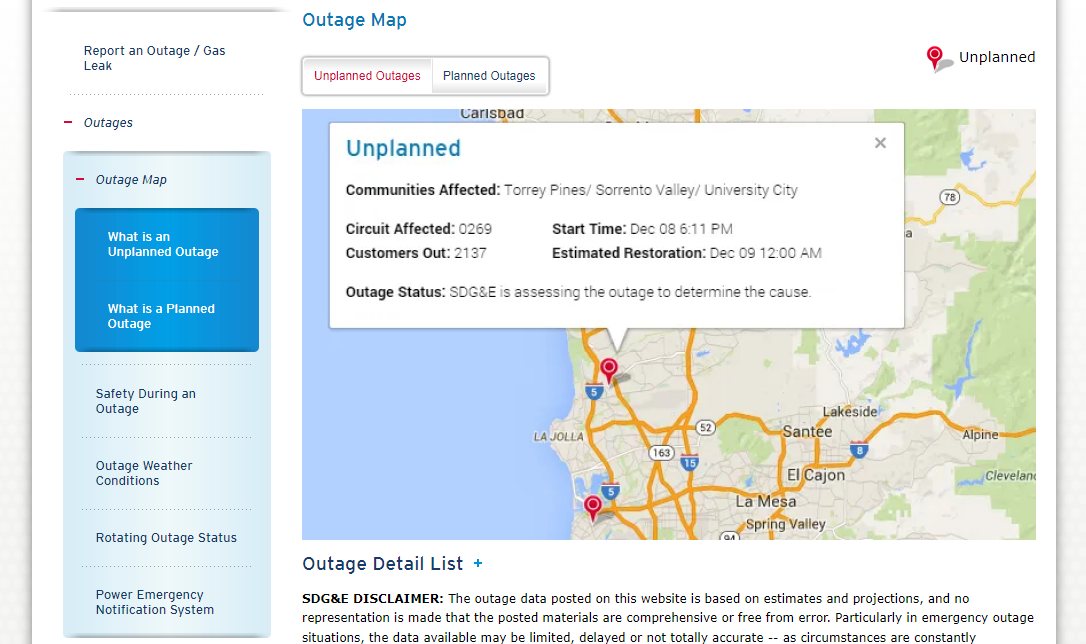
The sdge.com outage map was underperforming. Outage data updated only once every 4 hours, the map was not usable on mobile devices, and it crashed during outages, exactly when customers needed it.
Outage information was spread across 8 separate web pages, so customers who could not find current status called the call center instead.
My role
My task was to build a new outage map that served what customers needed during an outage. I became the single-threaded owner of all customer-facing outage and fire safety information.
How I solved it
- 1
Research the industry and our customers
I studied how other energy companies delivered outage information, and combined call center data, customer feedback, web and app analytics, and grid operations input to set priorities.
- 2
Design for simplicity
One responsive map replaced 8 pages, with interactive data overlays and the most important information front and center. It worked on every device and inside the mobile app.
- 3
Build on proven map technology
We used our developers' expertise with Google products and Google's map display technology, and designed the map to hold up under high-volume outage events.
- 4
Get the data faster than IT thought possible
Several IT leaders said outage data could not come faster than every 4 hours. I worked directly with the responsible IT team on an API and SLA that first delivered new data every 5 minutes, then moved the map to near-real-time updates under 300 milliseconds.
- 5
Measure every event
We tracked call volume per outage event after launch to confirm the change held across later events.
Results
- Performed without failure under severe load, including the unprecedented widespread outage of 2011.
- Became a prominent feature on live TV coverage and a core tool in every Emergency Operations Center event.
- Extended outage information to mobile devices and the mobile app, widening the channels customers could use.
- Saved $80K per major outage in call center costs; across 10 to 20 outage and fire safety events a year, that is $1M+ a year.
Tools and stack
- Google Maps platform
- Outage data API and SLA
- Responsive web
- iOS
- Android
- Push notifications
- Google Analytics