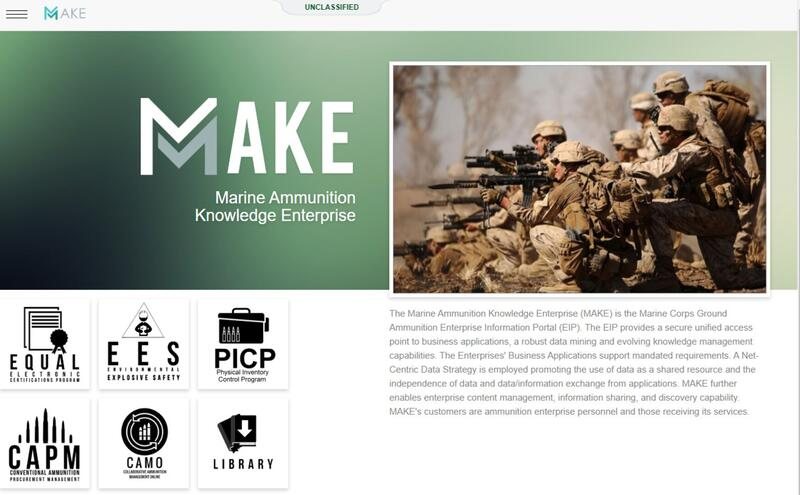
The challenge
I inherited a legacy product that no longer met the Marines' needs. The Marine Corps explosive safety team ran inspections at bases around the world on a 20-year-old, unsupported system that was only available back at the hotel.
The program had promised the Marine Corps a new app every 3 months. When I took over, the team was 6 months in with nothing shipped, so we narrowed to one app at a time, starting with the safety qualification system.
Inspections lasted 1 to 2 weeks per base. Inspectors spent every night entering the day's findings, then the entire last day building and revising the report for the base captain.
The new system also had to earn an ATO at DoD Impact Level 4 (IL4) in Azure Gov Cloud, which no Navy or Marine Corps system had done before. A typical ATO took 2 years, and up to 4 years depending on the complexity of the system.
My role
I owned the MAKE program in the cybersecurity division at NSWC Corona: the requirements and product vision for the Marine Corps ammunition and explosive safety teams, the business case, and delivery.
As principal program manager, I led the ATO under NIST RMF / 800-53 and the IL4 certification and deployment on Azure Gov Cloud.
While I ran the program, the Marine Corps ordnance inventory system (OIS-MC) was rolled into MAKE. That put 1.2 billion pieces of ammunition at 160 locations worldwide under MAKE (Marine Corps Systems Command (opens in a new tab)), and the Marine Corps spends $500M+ a year replacing ammunition (NDIA, PM Ammunition brief (opens in a new tab)).
How I solved it
- 1
Learn how Marines actually work
I walked inspections on site with the safety inspectors, interviewed subject matter experts, mapped the process in flow diagrams, and studied the legacy system. I held weekly working sessions with the experts until the requirements were fully defined, briefed the PM AMMO leadership team every 2 weeks, and walked through the work with power users in the field and in the office.
- 2
Turn skeptics into partners
I flew out to meet Marine Corps leadership, summarized what they needed in an executive 6-pager, explained what Agile delivery would look like, and set up open channels to clear roadblocks quickly. I presented progress to senior leadership every 6 months.
- 3
Rebuild it for the field, in the cloud
We built new enterprise software from the ground up on a lean budget, using open source tools wherever possible. Inspectors could now update findings in real time on base, and the system generated the inspection report on the fly.
- 4
Certify it in record time
I built a security-first team culture: engineers owned the application and server STIGs, and a junior team member took on the security documentation. I learned every step of the approval process, prepared documents ahead of each step, and met the Navy program executive office every 2 weeks to clear roadblocks.
- 5
Ship every 2 weeks
I ran Agile and DevSecOps delivery with a release every 2 weeks. When subject matter experts were unavailable, I made the call and revisited it with them in a later sprint.
Results
- Tracks 1.2 billion pieces of ammunition at 160 locations worldwide, with $500M+ a year in ammunition replaced, after OIS-MC was rolled into MAKE.
- The first system across the Navy and Marine Corps to earn an approved ATO at IL4 in Azure Gov Cloud.
- Named Best in Breed by the DoD Explosives Safety Board (July 2019) and recognized by the Office of the Secretary of Defense as a best practice for the other services.
- Auditors needed only one round of review at each approval step, where 2 to 4 rounds over 2 to 8 weeks were typical; each step closed in under a week.
- On a $1M to $3M yearly budget, MAKE met needs that competing systems costing other military branches $18M to $25M a year were built for.
- Automated ammunition request approvals on $200M+ a year in transactions, 30x faster.
- Led a white paper on Navy cloud deployment into IL4, shared with the other DoD branches.
- Later adopted by all five service branches; the program has since grown to $30M+ a year.
Source: NAVSEA, Jan 3, 2020: MAKE application becomes one-stop shop for Marine Corps ammo
Tools and stack
- Azure Gov Cloud (IL4)
- NIST RMF / 800-53
- DISA STIGs
- ReactJS
- GitHub
- TeamCity
- Splunk
- JIRA
- Confluence
- Azure DevOps
- Open source tooling
References
Sources cited on this page, plus industry standards and guidance relevant to this work.
- Tracking ammo gets easier: Corps launches innovative information module (Sep 26, 2017) (opens in a new tab)Marine Corps Systems Command
- Program Manager Ammunition, Marine Corps Systems Command brief (Mar 30, 2016) (opens in a new tab)NDIA
- Answering the call to readiness: NSWC Corona's MAKE application becomes one-stop shop (Jan 3, 2020) (opens in a new tab)NAVSEA
- DoDI 8510.01, Risk Management Framework for DoD Systems (opens in a new tab)Department of Defense
- Risk Management Framework (SP 800-37) (opens in a new tab)NIST
- SP 800-53 Rev. 5, Security and Privacy Controls (opens in a new tab)NIST
- Cloud Computing Security Requirements Guide (IL2 to IL6) (opens in a new tab)DISA, DoD Cyber Exchange