The challenge
The clinical team judges how healthy each person under review is. To do that well, clinicians need 100% confidence that they are seeing the most recent, complete health picture, including every critical factor that affects health, positively or negatively.
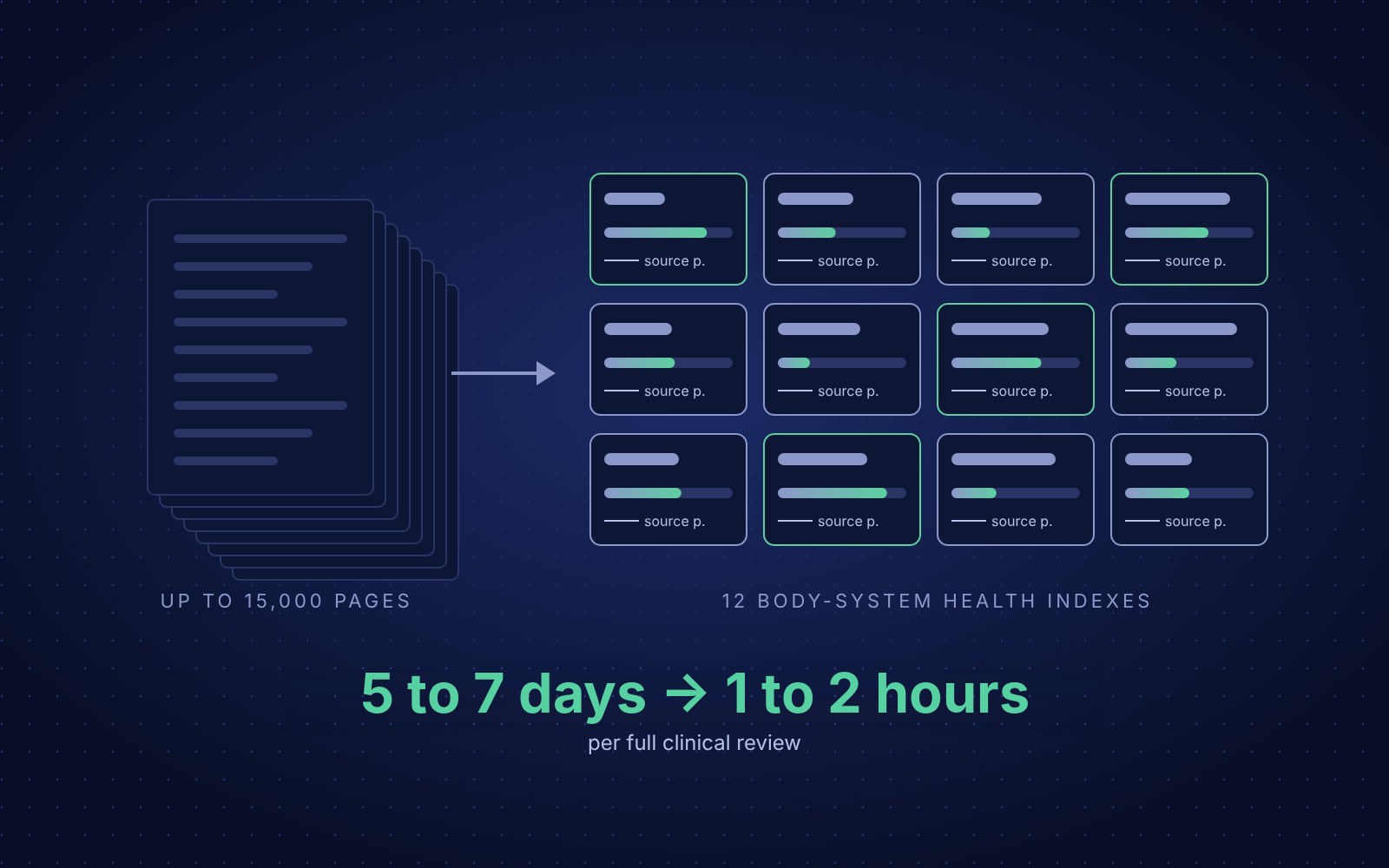
Clinicians reviewed every case by reading its medical records page by page, up to 15,000 pages per case.
The records came from many providers, in mixed formats and in no chronological order. Clinicians built timelines and cross-referenced conditions, labs, and medications by hand, and cases waited in queues and moved between reviewers before anyone reached a conclusion.
A full review took 5 to 7 business days, and each clinician completed 3 to 4 cases a week.
My role
I interviewed the clinicians and the medical director to map how they actually reviewed records, then designed the front-end interface from scratch and prototyped it with them before engineering built it.
With the medical director and data science, I defined the 12 health indexes, and I built and validated the medical rules data science used to sort each condition into the right index. I wrote the acceptance criteria, trained the QA team to validate the tool, set up the review-time tracking, and owned the go or no-go sign-off for release.
How I solved it
- 1
Listen to the clinicians
Interviews with clinicians and the medical director showed the real work: finding each condition across thousands of pages, putting it in order, and proving where it came from.
- 2
Define the health indexes
Together with the medical director and data science, we set 12 body-system indexes, from cardiovascular and pulmonary to nutrition and social factors, each with clear criteria.
- 3
Write and validate the medical rules
I built and validated the rules that place each condition, lab, and medication in the right index and criterion, so data science could automate the sorting.
- 4
Link every finding to its source page
The key decision. Clinicians cannot be 100% confident in what they cannot check, so every finding shows its record set, date, clinician, and specialty, and links to the page it came from. The AI organizes and flags; the clinician makes the call.
- 5
Hold the release, earn the trust
Halfway through rollout, the medical director asked for the raw digitized data side by side with the indexes before her team would use the tool. Adding it mid-release would have pushed the launch back at least a month and skipped QA, so I held the release date, put her request on the roadmap with a spec and mockup, and shipped it the next sprint.
- 6
Validate before release
I trained QA to test findings against the source records, measured review time in the platform, and gave the go or no-go sign-off only when the output held up.
Results
- Cut a full clinical review from 5 to 7 business days to 1 to 2 hours, measured in the platform with tracking I set up.
- Clinicians went from 3 to 4 cases a week to 3 to 6 cases a day.
- Clinicians now read about 200 pages of flagged findings instead of up to 15,000.
- Every clinician adopted the summary as the way they start a case, and they trust it because they can check any finding against its source page.
- The medical director's request drove the next release: the digitized source data shown side by side with the 12 indexes, shipped the following sprint.
- What I learned: trust is a deliverable. Speed came from the indexes; adoption came from the source links. Next time I would design the verify step in from day one: explain the process, show every transformation, and give clinicians a way to check it.
References
Industry standards and guidance relevant to this work.
- The HIPAA Privacy Rule (opens in a new tab)U.S. Department of Health and Human Services
- AI Risk Management Framework (opens in a new tab)NIST
- ICD-10-CM diagnosis classification (opens in a new tab)CDC, National Center for Health Statistics
- FHIR health data interoperability standard (opens in a new tab)HL7