The challenge
AI requests arrive from every direction. A chemist wants literature connectors, a brand team wants email copy, an acquired team arrives with its own AI habits, and vendors ship new features every week. In my current role I see this first hand: we moved our product and tech teams from ChatGPT to Claude, and new Claude features arrive several times a week, each one a gating decision. Without one front door, each request becomes a one-off debate: risky requests can slip through while low-risk ones wait.
A drug maker also carries rules most companies do not: GxP records and 21 CFR Part 11, FDA promotion review, patient data under HIPAA authorizations, and material non-public information around trial readouts. Governance has to be strict where those rules apply and fast everywhere else.
My role
I researched the business lines, the Soleno acquisition, and how drug makers use AI from public sources, then designed and built the clickable concept with Claude. Every request, user, cost, and metric in it is fictional.
My thesis: treat each approved AI capability as a product, with an owner, a risk tier, a rollout plan, and success measures, and gate it by group the way a product team gates a feature flag.
The concept builds on work I do today: I sit on my company's AI council with the chief legal officer, CTO, VP of IT and VP of data science, where we decide which AI tools and features each team may use and what data each one may touch.
How I analyzed the problem
I scored every request on six dimensions, out of 17 points, and mapped the total to four tiers: Tier 1 at 0 to 4, Tier 2 at 5 to 8, Tier 3 at 9 to 12, and Tier 4 at 13 and up. Hard rules raise the tier whatever the score, for example promotional output that reaches HCPs, or patient data with a vendor that is not approved.
| Dimension | What the requester answers | Why it matters here | |
|---|---|---|---|
| 1. Data sensitivity | Public literature up to PHI, GxP records, and MNPI | The most sensitive data type sets the score | |
| 2. Regulatory exposure | Which rules the data brings into play | IP, GxP and Part 11, HIPAA, FDA promotion, SOX | |
| 3. AI autonomy | Drafts for review, informs a decision, takes actions, or runs on its own | Actions in company systems need tighter controls | |
| 4. Output exposure | Requester, team, company, or HCPs, patients, and regulators | External output triggers MLR and Form 2253 | |
| 5. Vendor status | Feature already on, new capability, new vendor, or unvetted tool | New vendors need security and contract review | |
| 6. Scale | Number of users | Wider rollout raises the cost of a mistake |
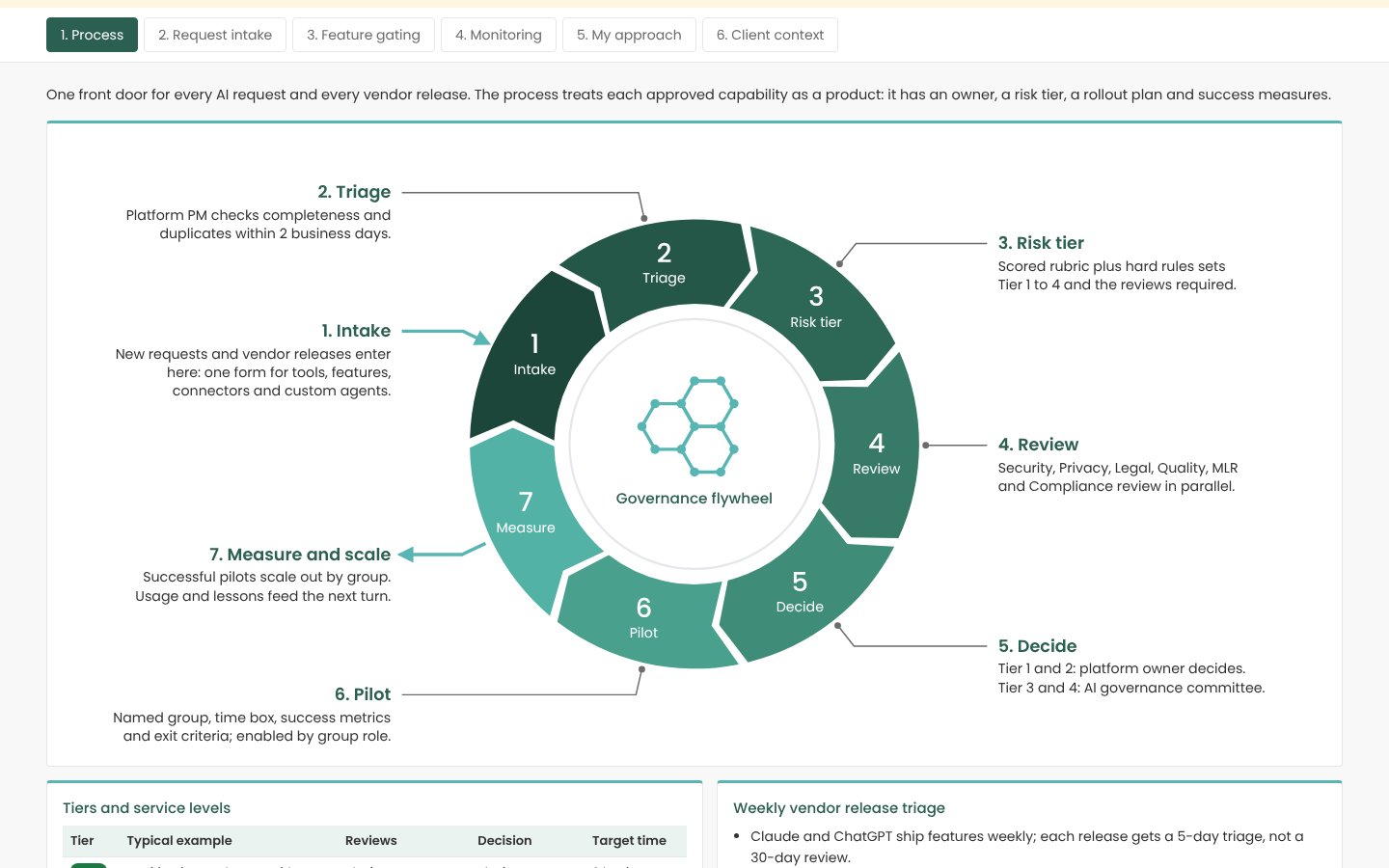
The platform owner decides Tier 1 and 2 requests. Tier 3 and 4 go to the AI governance committee with a one-page memo that the intake form writes. Target decision times run from 2 business days at Tier 1 to 30 at Tier 4.
How I solved it
- 1
One front door
One intake form covers new tools, new features, connectors, and custom agents. Vendor releases get a weekly triage instead of a 30-day review.
- 2
Score the risk, not the request
Six scored dimensions plus hard rules set the tier, and the tier sets the reviews, the decision owner, and the target time.
- 3
Review only where needed
Security, Privacy, Legal, Quality, MLR, and Compliance review in parallel, and only when the tier requires them.
- 4
Pilot with named groups
Every pilot has a named group, a time box, success measures, and exit criteria. Features turn on through group roles, never company-wide by default.
- 5
Budget with usage profiles, not token guesses
Requesters pick a usage profile instead of guessing tokens. The form shows a monthly cost range, and measured usage from admin analytics replaces it after 2 weeks of pilot.
- 6
Measure, then scale, adjust, or retire
Adoption, time saved, token cost, quality signals, and incidents feed the next turn of the flywheel, and successful pilots scale out group by group.
Results
- Built and tested in a headless browser at desktop and phone widths, in light and dark mode.
- The Feature gating view sets On, Pilot, or Off for each feature by group, and flags every change from the default.
- Includes a 30, 60, and 90 day plan for the role.
- Concept work from public information only. Not affiliated with or endorsed by Neurocrine Biosciences.
Try the prototype
Fully clickable, with fictional data. Open Request intake and load a worked scenario to watch the tier, reviews, rollout plan, and cost range change, then open the committee memo. The footer switch changes light and dark mode.
Tools and stack
- Claude
- Agentic AI pipelines
- Public-source research
- HTML / CSS / JavaScript
- Inline SVG
- Headless browser testing
References
Industry standards, regulations, vendor controls and pharma AI examples behind this work.
- AI Risk Management Framework (opens in a new tab)NIST
- ISO/IEC 42001:2023, AI management systems (opens in a new tab)ISO
- The HIPAA Privacy Rule (opens in a new tab)U.S. Department of Health and Human Services
- Draft guidance: AI to support regulatory decision-making (opens in a new tab)U.S. Food and Drug Administration
- Guiding principles of good AI practice in drug development (opens in a new tab)U.S. Food and Drug Administration
- 21 CFR Part 11 (opens in a new tab)eCFR
- 21 CFR 314.81 (Form 2253) (opens in a new tab)eCFR
- Claude Enterprise: custom roles and role-based permissions (opens in a new tab)Anthropic
- ChatGPT Enterprise: role-based access control (opens in a new tab)OpenAI
- Claude Code docs: Manage costs effectively (opens in a new tab)Anthropic
- Claude Enterprise consumption guide (opens in a new tab)Anthropic
- Claude for Life Sciences (opens in a new tab)Anthropic
- Lilly launches TuneLab (opens in a new tab)Eli Lilly
- Sanofi digital and AI (opens in a new tab)Sanofi
- AstraZeneca scaling generative AI (SCOPE 2025) (opens in a new tab)Clinical Research News
- Merck and McKinsey CSR platform (opens in a new tab)EMARKETER
- Sanofi, Formation Bio and OpenAI trial tool (opens in a new tab)Fierce Biotech
- Pfizer Charlie platform (opens in a new tab)Storyboard18
- Agentic AI for MLR (opens in a new tab)Veeva
- OpenAI and Moderna partnership (opens in a new tab)MobiHealthNews