I've applied through Workday more times than I can count, at many employers over many years. I've also worked on the other side, as the product and implementation lead building candidate flow that feeds an applicant tracking system like Workday or Greenhouse. Two pieces put words to what I experienced: Matt Alston's Business Insider essay, Everyone hates Workday (opens in a new tab), and Nilay Patel's Decoder interview (opens in a new tab) with Gerrit Kazmaier, Workday's president of product and technology.
Customer service is Workday's goal. It's just that the customer isn't you.
The 2% and the 98%
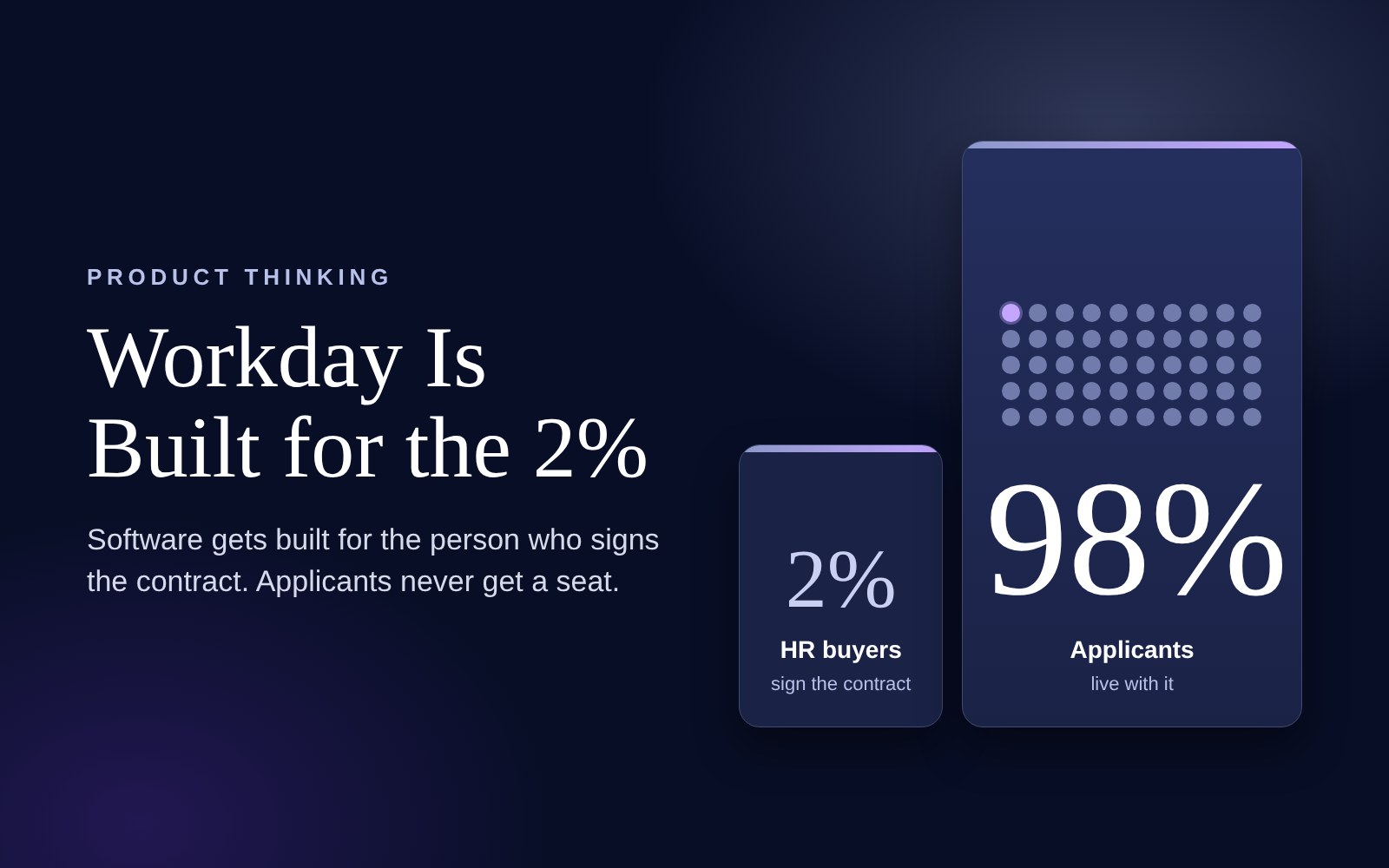
HR teams run about 2 people for every 100 employees.[5] That 2% buys Workday. Workday counts its users by the employees under contract, and applicants are not in that count at all.[7] In the first half of 2024 alone, Workday's customers processed 173 million applications against 19 million job openings, and applications grew more than four times faster than openings.[6]
My 98% is a frame, not a measured statistic. The numbers point the same way: the people with budget are about 2% of a company, and for a competitive role the applicants outnumber everyone on the hiring team many times over. Here is who touches Workday Recruiting, and what each group gets from it:
Buyer
CHROs and HR VPs with the budget. They want one suite for tracking, onboarding, benefits, time and PTO.
Admin
The HR and HRIS staff who configure it. They complain about it too.
Recruiter
Works candidates every day inside a system designed around HR records.
Applicant
The largest group by far, and not counted as a user.
Kazmaier said plainly who the product serves when he described the work Workday supports:
Those are the jobs on the HR side.
Why HR leaders buy it anyway
I built a recruiting startup's candidate flow alongside a chief HR officer and an executive recruiting specialist, and I've talked with senior recruiters who have worked in Workday for years. They all gave me the same answer. Workday handles the work HR doesn't want to do or finds hard to do: tracking, onboarding after the hire, benefits, time and PTO. None of that touches the experience of the 98%.
The decision makers are the VPs and chief HR officers who hold the budget and want one piece of software that handles it all. That's who Workday sells to. A bad applicant flow doesn't affect them, so it never makes their list. Even the internal people who administer the system complain about it. The most-recommended reader comment on the Decoder interview came from a Workday admin:
Workday is actually 50+ applications duct taped together
What I've experienced as an applicant
Every Workday employer makes me create a new account and rebuild my profile from scratch. Half the time it doesn't read my resume correctly, so I retype every job and every date I just uploaded. The defaults are poorly designed: on some forms I can't type "United States" into the country field, so I scroll through every country to find it. The same thing happens at employer after employer.
Workday's answer is that each employer sets up its own process. Its clients, a spokesperson told Business Insider:
configure the application process for each job to fit their unique hiring processes and needs.
That answer doesn't hold up. Workday built every one of those settings and decided what each one starts as, and most employers ship the defaults out of the box. If Workday cared about the 98% of people who use the software, it could make that experience streamlined and effective for every employer at once. The defaults are where a product's taste shows. Patel named the result on Decoder:
We're literally shipping the org chart in the nature of this process.
Every stakeholder adds a field, and the applicant fills in all of them. The cost is measurable. In Appcast's 2025 data, jobs that take 1 to 5 minutes to apply convert at 5.37%, and jobs that take 16 minutes or more convert at 3.09%, about 42% fewer applies.[9] In Talent Board's research, 36% of US candidates hadn't heard back one to two months after applying.[12]
Nobody with budget owns those numbers. In my article Find the Person Who Pulls, I wrote that pull is something a specific person has. The applicant has the problem, and no one with pull feels it.
What I've experienced as a builder
As the product and implementation lead at a recruiting-tech startup, I designed the candidate flow that had to land in an applicant tracking system. Workday was unusable for what we were trying to do. We had no way to onboard candidates into it and no way to deliver our flow to it, because it's a system built for HR to manage people after they're hired.
Greenhouse was the opposite. We accessed its APIs and fed our data into it simply and easily. We also worked with custom candidate-flow software that made tracking, reporting and analyzing scorecards simple, fast and effective. That stack is how I helped deliver 50+ senior hires for GitLab in 5 months before its IPO, as a consultant to a boutique AI recruiting firm.
Why Greenhouse works better
Recruiter buyer
Its buyer is talent acquisition, the people who use it every day, so usability wins the sale.
Open APIs
Best-in-class candidate tools plug in instead of fighting the system.
Structured hiring
Scorecards make hiring manager feedback fast and comparable.
Fast apply
Modern tech onboards a candidate fast, accurately and completely in under 5 minutes.
Greenhouse also gives job seekers one MyGreenhouse account to apply to multiple companies.[11] Across more than 13,000 companies, Greenhouse now runs on more of them than Workday does (19.0% vs 17.5%), while Workday holds over 40% of the Fortune 500.[10] The split tracks the buyer. Where talent acquisition buys, the applicant is one step from the decision. Where the suite buys, the applicant is lost in a Byzantine labyrinth.
Workday has admitted the problem
On Decoder in May 2025, Patel asked Kazmaier whether he applied for his own Workday job through Workday.
No, I did not.
The top reader comment said the commenter stopped reading at that line. About 17 months later, Workday announced Candidate Profile, which lets job seekers save their information once and prefill about 80% of standard fields at any Workday employer.[3] Kazmaier said:
We've heard the feedback from job seekers, and they're right.
It's a real step, and it's still built for the buyer. It reaches general availability in early 2027, employers can opt out in their tenant configuration, and each employer still creates its own candidate account.[4] The 2% still decides whether the 98% get the fix.
How I'd fix it: change the buyer
The fix starts with who sits at the table. Give talent acquisition and candidate metrics a real vote in the purchase decision. If I were helping an HR leader choose an applicant tracking system, these are the questions I'd put on the scorecard:
- Who on the buying team has applied through this system in the last year?
- How long does it take to apply to one of our jobs on a phone? Time it.
- What is our apply rate, where do candidates drop off, and who owns that number?
- Does the resume parse correctly, or does the candidate retype it?
- Can a candidate apply without creating a new account?
- Can best-in-class candidate tools plug in through open APIs?
- Does the head of talent acquisition have a vote, with candidate metrics on the scorecard?
AI can generate a form in seconds. It takes a person with taste to decide what the applicant should never have to type twice. Until the people who apply have a voice in what gets bought, Workday will keep building for the 2%.
How the 98% holds up
I checked my frame against the data. The applicant share depends on the lens:
| Lens | Inputs | Applicant share |
|---|---|---|
| Per job opening (Workday average) | 173M applications / 19M openings = 9.1 per opening [6]; 3 to 7 internal people per opening (my assumption) | 57% to 75% |
| Per hire, competitive roles | 291 applications per hire [8]; 3 to 7 internal people (my assumption) | 97.7% to 99.0% |
| Whole company | 1.98 HR staff per 100 employees [5] | 98% of employees are not HR |
For the roles most people compete for, the 98% holds. For Workday's average opening, applicants are still the majority of the people who touch it.
References
Where I first heard this and the source material.
- Everyone hates Workday, Matt Alston (opens in a new tab) Business Insider, May 6, 2024
- Why Workday's new product head hopes he can make you like Workday (opens in a new tab) The Verge, Decoder, May 2025
- New Workday Candidate Profile lets job seekers save their information once (opens in a new tab) Workday, Oct 13, 2026
- Workday Candidate Profile employer FAQ (opens in a new tab) Workday Community
- CHRO benchmarking survey insights (1.98 HR staff per 100 employees) (opens in a new tab) SHRM, Jul 10, 2025
- Workday Global Workforce Report (173M applications, 19M requisitions, H1 2024) (opens in a new tab) Workday, Sep 10, 2024
- Workday Form 10-K, fiscal 2026 (75M users under contract, 65%+ of the Fortune 500) (opens in a new tab) SEC
- Recruiter productivity (291 applications per hire) (opens in a new tab) Ashby, Apr 28, 2026
- 2026 Recruitment Marketing Benchmark Report (apply rate by apply time) (opens in a new tab) Appcast
- 2026 ATS Usage Report (opens in a new tab) Jobscan, Aug 20, 2026
- Meet MyGreenhouse: a new kind of candidate portal (opens in a new tab) Greenhouse, Apr 8, 2025
- Talent Board candidate experience research (opens in a new tab) SHRM, Apr 9, 2024